|
|
The Battle of
Paroi
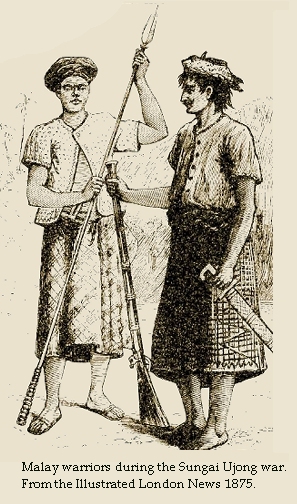 While the British were busy
trying to put down the Malay revolt in Perak, another
revolt was brewing in the south of the Malay peninsula
in what is today known as Negeri Sembilan. The Sungai
Ujong War was prompted by the appointment of a British
Resident to assist the Dato' Kelana in ruling Sungei
Ujong. The other Malay chiefs, led by Yamtuan Antah of
Seri Menanti, were enraged by this move and, encouraged
by the Perak revolt occurring in the north of the
Peninsula, moved to drive the British out of Sungai
Ujong. At the end of November 1875, reports reached
Murray that Yam Tuan Antah had deposed the chief of
Terachi appointed by the Dato' Klana and he led a small
force of 20 men of the 10th Regiment of Foot and 30
local policemen into the Terachi valley to investigate.
In actual fact, the chief of Terachi had not been
deposed but had switched allegiances to the Yamtuan.
Murray's force encountered a group of hostile Malays and
a skirmish ensued. With reports of more Malays
converging to the area and the British running out of
ammunition, Murray beat a hasty retreat back to Rasah.
The Yamtuan's forces then advanced into Sungai Ujong,
attacking and capturing the police station at Paroi and
occupied Kampung Ampangan on the east bank of the Linggi
River. While the British were busy
trying to put down the Malay revolt in Perak, another
revolt was brewing in the south of the Malay peninsula
in what is today known as Negeri Sembilan. The Sungai
Ujong War was prompted by the appointment of a British
Resident to assist the Dato' Kelana in ruling Sungei
Ujong. The other Malay chiefs, led by Yamtuan Antah of
Seri Menanti, were enraged by this move and, encouraged
by the Perak revolt occurring in the north of the
Peninsula, moved to drive the British out of Sungai
Ujong. At the end of November 1875, reports reached
Murray that Yam Tuan Antah had deposed the chief of
Terachi appointed by the Dato' Klana and he led a small
force of 20 men of the 10th Regiment of Foot and 30
local policemen into the Terachi valley to investigate.
In actual fact, the chief of Terachi had not been
deposed but had switched allegiances to the Yamtuan.
Murray's force encountered a group of hostile Malays and
a skirmish ensued. With reports of more Malays
converging to the area and the British running out of
ammunition, Murray beat a hasty retreat back to Rasah.
The Yamtuan's forces then advanced into Sungai Ujong,
attacking and capturing the police station at Paroi and
occupied Kampung Ampangan on the east bank of the Linggi
River.
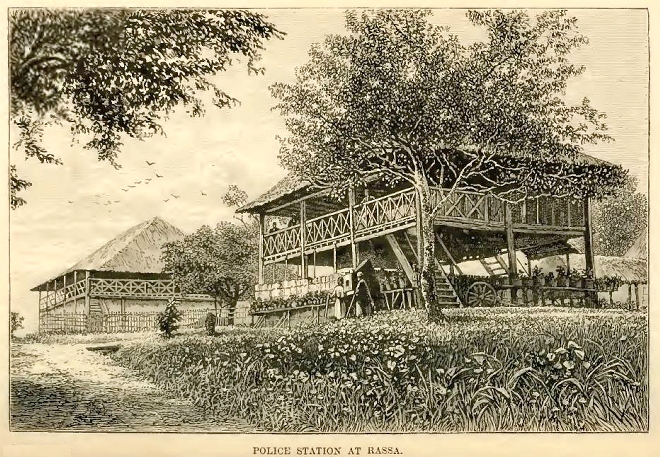
The Yamtuan's forces in Ampangan were now in a strong
position to threaten Rasah. Rasah, now a suburb of
Seremban, was then the chief mining centre of Sungei
Ujong - control of Rasah would mean control of the rich
tin revenues of Sungai Ujong. Murray's military
detachment was stationed at Bukit Rasah and consisted of
68 police, only 50 of whom were armed with rifles, and
45 men of the British 10th Regiment of Foot, commanded
by Lieutenant Hinxman. With the Malays in control of
Kampung Ampangan, they began to fortify the houses
there, in anticipation of a British attack. Murray
deployed some his forces and a battery of mountain guns
in the ridge on the opposite side of the river, Bukit
Ampangan. Murray had established his Residency on Bukit
Ampangan in order to be close to the Dato' Klana's
residence, which was located at the point where the
ridge runs down to the Linggi River. Murray had sound
political reasons for staying at the Residency, close to
the Dato' Klana. As long as he was there, within a few
hundred yards of the Dato' Klana's house, his presence
gave moral support to the unsteady nerves of the Dato'
Klana. If Murray withdrew to his main force at Rasah,
the Dato' Klana would probably have bolted and his
flight might well encourage other Malays in Sungai Ujong
to rise against the British. The British positions
on Bukit Ampangan provided them with a commanding view
of the Malay stockades in Kampung Ampangan across the
Linggi River.
On the morning of 5 December, 1875, Murray advanced from
his Residency at Bukit Ampangan with a small detachment
to attack that strongpoint with his police. He also
brought artillery to bear on the Malay stockade and one
lucky shot went right through the house. Murray then
crossed, the river to the east bank and circled round,
to attack the house in the centre of the Malay position
from the rear. The surpise attack from the rear, coupled
by the bombardment from Bukit Ampangan, shook the
confidence of the Malay defenders and they retreated to
their stockades in Paroi. Much of the fighting had so
far been borne by local police troops, such as these.
However, as the fighting shifted to Paroi,
reinforcements began to arrive to support the British
counter-attack. Many of these were units that had been
dispatched originally to support the Perak campaign
against Maharaja Lela that had begun some weeks earlier,
but were now no longer required in Perak.Among these
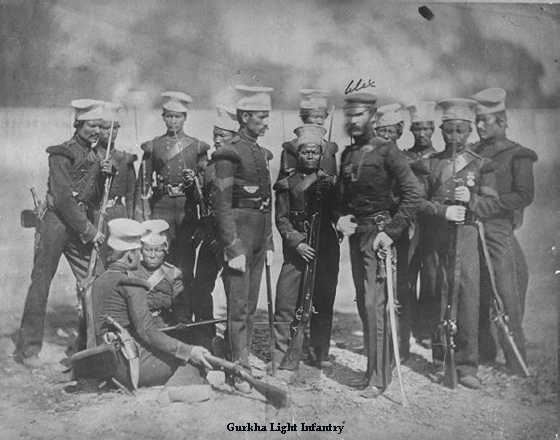
reinforcements were 350 Gurkhas en route from India to
Taiping that were diverted at Penang and shipped on to
Malacca. These were from the 1st Gurkha Light Infantry
and the Sungai Ujong campaign was the first time Gurkhas
had seen combat operations outside of India. The Gurkhas
were accompanied by half a battery of artillery, also
from India. Artillery had proven its usefulness at
Ampangan and Hinxman, in his bid for reinforcements, had
asked for more artillery to be provided to support his
infantry.
A force was also sent from Singapore consisting of a
body of 85 mercenaries commanded by a former French
naval officer, Captain A M Fontaine. This force had
originally been hired by Tengku Kudin of Selangor to
capture Klang from his rival Raja Mahdi four years
earlier. These mercenaries consisted of Arabs,
Egyptians, Somalis, Indians and other foreigners that
were found in Singapore and they were well-known for
their ruthlessness and ferocity. It was in fact the
arrival of these 85 mercenaries in Fontaine's 'Arab
Contingent' on December 6th 1875 that convinced Murray
to launch an early attack on the Malay stockades at
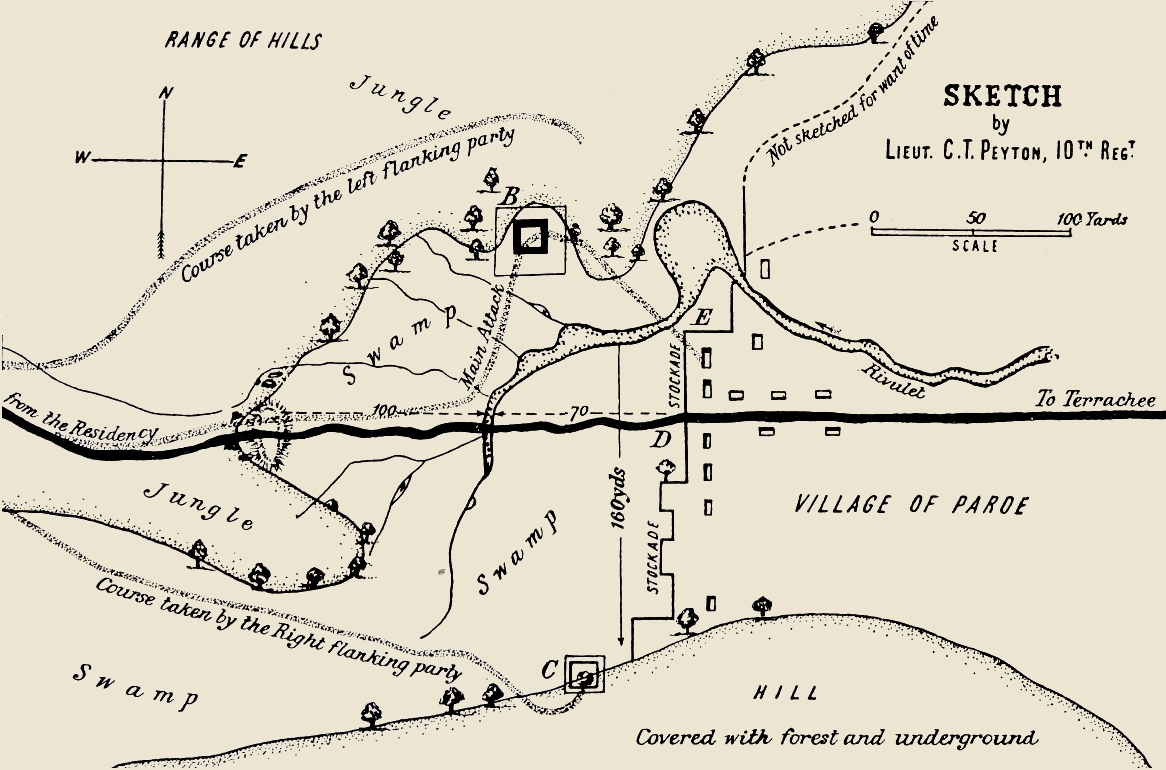
Paroi the next day. On 7 December, 1875, Hinxman set out
for Paroi from Rasah with a force comprising 35 men of
the 10th Regiment of Foot, 48 of Murray's police and
Fontaine's 85 Arabs. Their aim was to dislodge the
Malays from their stockades, which were located on both
sides of a bend of the Paroi River. The Malays were in a
strong position at Paroi. They occupied 20 houses most
of which had been strengthened and loopholed as firing
points. In front of the village a number of breastworks
had been built - semi-circular banks of earth. In front
of the breastworks was an open swamp extending 170
yards. The flanks of the Malay position were protected
by jungle-covered hills. It was believed that some 300 -
600 Malays held this position and that the Yamtuan Antah
himself was in personal command of this force.
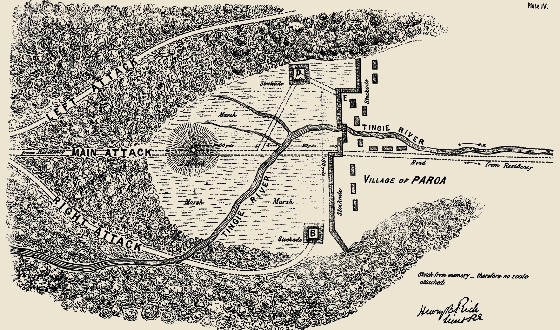
Hinxman sent out a detachment of Arabs on either side of
the Malay defences to work round under cover towards the
flanks of the Malay position. One of these parties was
unable to penetrate the dense jungle. The other party,
20 Arabs, reached the left flank of the Malay position,
surprised the Malays and killed some of them, but was
obliged to retreat because of fire from other Malay
posts overlooking them from higher ground. There was
then an hour's exchange of fire between the two sides
across the swamp. The Malay fire was not heavy but
Hinxman's force suffered casualties and he was making no
progress. Hinxman hen led 20 British soldiers and Arabs
with fixed bayonets in an advance across the open ground
towards the Malay centre. Owing to the broken ground,
the charge by Hinxman on the Malay centre lost direction
and veered towards the right flank of the Malay
position, near the bend of the river (pictured here).
Here they were pinned down by fire. At this point, the
British artillery finally arrived on the scene - it had
been delayed due to the swampy conditions of the area.
After ten well-directed rounds, the Malays began to
retreat. Hinxman led another charge from their position
on the flank and the Malay stronghold at Paroi was
taken. Casualties had been heavy on both sides. The
British and Arab contingents had 37 killed and wounded.
The Malays lost about 35 killed and a large number
wounded
Details of the battle of Paroi can be found in
'Professional papers of the Corps of Royal Engineers'
(Chatham Royal Engineers 1877) which is available for
download at The
Internet Archive.
Write to the WebMaster: sabrizain@malaya.org.uk
The
Sejarah Melayu
website is maintained solely by myself and does
not receive any funding support from any
governmental, academic, corporate or other
organizations. If you have found the Sejarah
Melayu website useful, any financial
contribution you can make, no matter how small,
will be deeply appreciated and assist greatly in
the continued maintenance of this site.
|
|